

“When you’re one of the only surgeons working in a war zone, your specialty doesn’t matter. You must do everything you can to save the life in front of you. That’s why THE HES BOOK – LIKE our courseS – covers every field of trauma, giving both surgeon and patient the best possible chance of success.”
David Nott of the David Nott Foundation
HES Resources for humanitarian surgeons include the HES Book - created by Pete Mathew and David Nott - have over fifty years of experience in humanitarian and military/war surgery in a wide range of conflict zones. You can read more about the authors here.
The HESBook provides a practical, logical, no-nonsense approach to the acute management of casualties with penetrating wounds caused by bullet strikes and fragments from exploding munitions, with effective decision-making tools and surgical techniques used successfully by them in the field for many years. The content aligns with the Frontline Course on trauma surgery delivered by the David Nott Foundation.
A unique freature of the book is that the HES Book will evolve over time, in response to changing needs in hostile environments. This website will supply updates to existing content and provide new material. For more information, see the New Content page.
The printed verision of the book is only available in ENGLISH currently, but a UKRAINIAN version (digital) will be available by the end of November, with an ARABIC version to follow in early 2026.


ABOUT the HES Book
Helvetica Light is an easy-to-read font, with tall and narrow letters, that works well on almost every site.
This invaluable surgical decision-making resource covers the vast range of skills required by surgeons, who have to control haemorrhage, prevent contamination and infection, repair 'vital' structures, and achieve closure of wounds, including the performance ot traumatic amputations. It encompasses techniques from general, cardiothoracic, vascular and orthopaedic surgery, neurosurgery, maxillofacial and plastic surgery, as well as burns injuries and obstetric interventions.
WHO IS THE HES BOOK FOR?
Surgeons working in chaotic emergency facilities in war zones, in far from ideal clinical conditions,with restricted resources and time. It is also for surgeons preparing to work in such places, for whom the prospect can be daunting. It's main purpose is to provide reassurance for managing the damage caused by penetrating wounds of war.
WHAT DOES THE HES BOOK COVER?
The core practical skills required by surgeons faced with injuries from grenades, mortar bombs, rockets, improvised explosive devices (IEDs) and anti-personnel mines - with the short-term aim of ‘a live casualty’ with the potential for restoration of as much function as possible.
WHY IS THE HES BOOK UNIQUE?
Unlike any other book on the subject, this sharply focused no-nonsense text gives precisely the information surgeons want - without unnecessary ‘filler content’. Great care has been taken to maximise the clarity of the directions and descriptions alongside surgeon-drawn diagrams and hundreds of photographs of procedures. The unique approach that provides a decision-making framework that focuses on the technical aspects of surgical treatment of open wounds. The information arranged in four main colour-coded sections.

WHAT'S IN THE BOOK?
_tif.png)
_tif.png)
SECTION I
Here you will find a checklist of surgical approaches to access 'vital' structures, including the brain. Each anatomical region is considered in a logical sequence. The section can also be used as a dissecting-room guide, to practise the incisions and dissections required to gain appropriate access.
SECTION II
This section describes all the potential initial surgical actions necessary to save life while preserving the potential for as much normal function as possible. It gives, in great detail, all definitive surgical techniques and (where appropriate) simpler and quicker surgical options for ‘damage control’.
_tif.png)
APPENDICES
Covers the subsequent actions required to maximise chances of restoration of normal function, covering wound closure, soft tissue healing, bone healing, burns management and obstetric emergencies.
_tif.png)
SECTION III
This is the framework for decision-making, which applies information from Sections I and II to the acute clinical reality. It considers the site of penetrating wounds and systemic blood pressure after resuscitation attempts, with the immediate aim of stabilising the casualty and preventing the development of infection.
_tif.png)
SECTION IV
Describes the subsequent actions for achieving soft tissue healing and bone healing, with the ultimate aim of restoring as much function as possible.

SECTIONS I & IIare the 'building blocks' required for the surgical decision-making processes covered in Section III.
"THE Format and structure of the book
are critical to its clinical value."

Contains hundreds of full-colour clinical photographs taken
during the authors' many missions in conflict zones.
Most topics laid out across self-contained double-page spreads.


Each section has colour-coded side tabs for locating information quickly and easily.
Decision-making processes illustrated succinctly by simplified flow diagrams and algorithms.


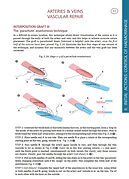
Surgical techniques described step by step, and align perfectly with illustrations - no need to turn pages to locate figures.


Surgeon-drawn diagrams ensure anatomical clarity and
tie in precisely with text descriptions.